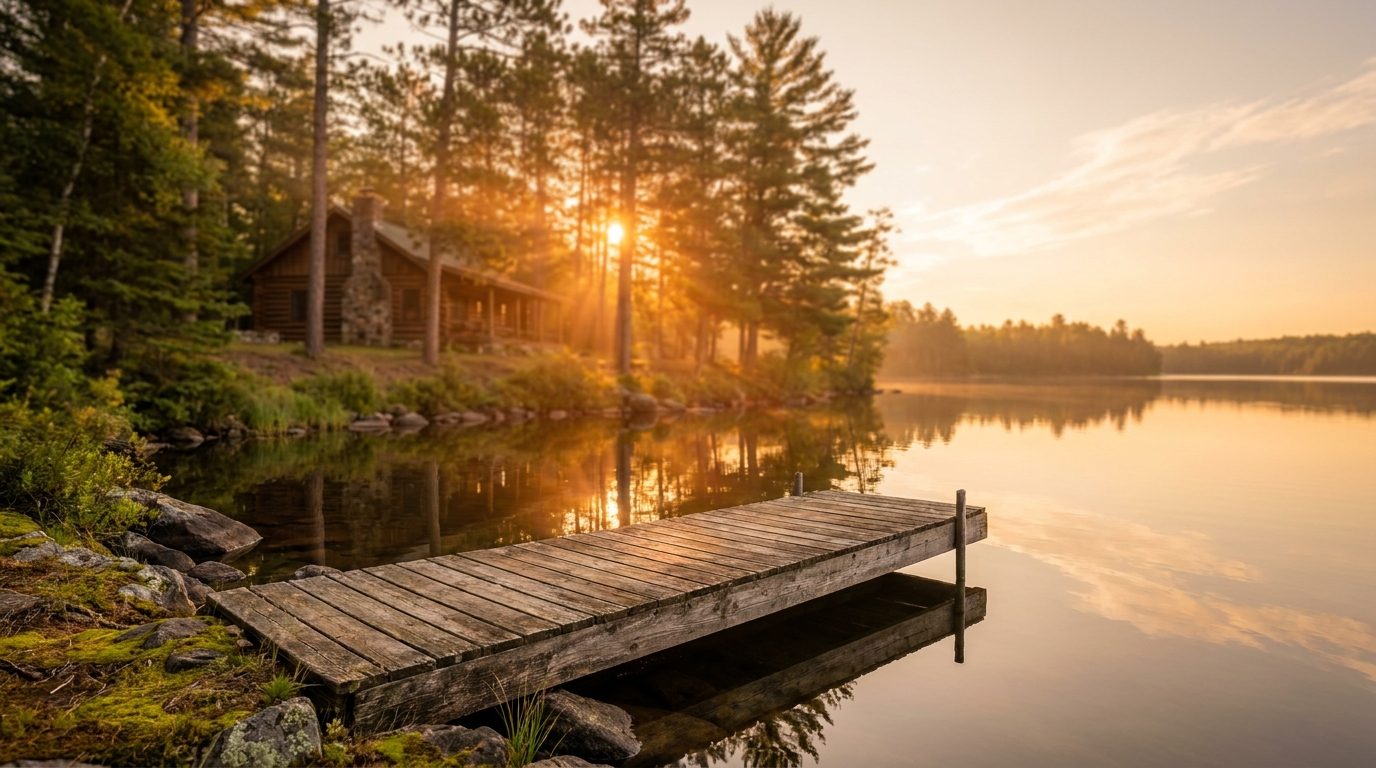
If you’re researching keeping the family cabin in the family in Wisconsin, you already know the stakes. A cabin isn’t just real estate. It’s the place four generations have learned to water-ski, the dock everyone fixes together over Memorial Day weekend, the one asset siblings will fight over precisely because they all love it. Unlike a house someone simply inherits and sells, a cabin usually has three or more heirs who all want to keep using it, and no instructions for how that’s supposed to work. This guide walks through what happens to a Wisconsin cabin with no plan, the three tools families actually use to keep it in the family, and the buyout and usage rules that prevent the fight nobody wants to have at a funeral.
What happens to a Wisconsin cabin with no plan
If a cabin owner dies without a trust, a transfer-on-death deed, or specific instructions in a will, Wisconsin’s intestacy statute, chapter 852 of the Wisconsin Statutes, or the terms of a simple will typically pass the cabin to the children in equal shares. That sounds fair, and it is, on paper. In practice, it means two, three, or five adult siblings now own the cabin together as tenants in common, each with an equal, undivided interest and none of them with any rulebook for how to share it.
Tenancy in common has a specific legal feature that catches families off guard: any one co-owner can force a sale. If one sibling needs cash, moves out of state, or simply stops speaking to the others, Wisconsin law allows that sibling to file a partition action asking a court to divide the property or, far more commonly with a single structure like a cabin, order it sold and the proceeds split. The other siblings don’t get a vote. A cabin that survived three generations can be gone in a single contested lawsuit, and the family often ends up worse off, and further apart, than if no one had inherited anything at all.
Even short of a lawsuit, an unplanned inheritance under Wisconsin’s intestacy rules leaves every real question unanswered: Who pays the property taxes and insurance? Who decides on a new roof? Can a sibling rent it out on Airbnb during the weeks they’re not using it? What happens when one heir dies and their quarter-share passes to their own kids, who may not even know the other cousins? None of that gets resolved by the statute. It only gets resolved by a plan someone puts in place while the current owner is still alive and everyone still agrees on the goal.
Why a cabin is a different estate planning problem than a house
Most estate planning assumes one owner, or a married couple, holding an asset until it’s sold or passed to a single heir. A cabin breaks that assumption in three ways. First, it usually has multiple heirs who all want to keep it, not sell it, which means the plan has to build a small, permanent business arrangement between siblings and eventually cousins. Second, the value people place on it isn’t purely financial: a heir who never visits still may not want to sell “their share” of the family history, which is exactly the emotional friction that turns into litigation. Third, cabins tend to appreciate significantly over decades on Wisconsin’s lakes, which means capital gains exposure, and how the property is titled at the first owner’s death can make a meaningful difference in the tax basis the next generation receives.
Because of all three, the families who successfully keep a cabin for a second and third generation almost always have something in writing: a trust, an LLC operating agreement, or both, spelling out who can use the place, who pays for what, and exactly how a departing heir gets bought out instead of forcing a sale.
Tool 1: A revocable living trust built around the cabin
The most common and most flexible solution is a revocable living trust under the Wisconsin Trust Code, chapter 701 of the Wisconsin Statutes. You deed the cabin into the trust while you’re alive, keep full control as trustee, and the trust document spells out exactly what happens to the cabin at your death: whether it’s held for all the children jointly, whether it’s sold with proceeds split, or whether it stays in further trust for a set number of years with specific rules for who can use it and when.
A trust does three things a bare inheritance can’t. It keeps the cabin out of Wisconsin probate entirely, since the trust, not the individual owner, holds title at death. It protects the cabin during your own incapacity, since your successor trustee can step in immediately to manage or maintain it if you can’t, with no court-supervised guardianship required. And it lets you write the rulebook in advance: a usage schedule, an expense-sharing formula, a requirement that major decisions need a supermajority of the sibling-beneficiaries rather than unanimous consent, and, critically, a buyout provision that lets one heir exit for a fair, pre-set price instead of forcing a partition sale that drags everyone else along.
The trap with any trust is funding. A trust that never actually holds title to the cabin does nothing; the deed still has to be recorded transferring the property from you, individually, to you as trustee of the trust. We cover the full mechanics in our guide to funding a trust in Wisconsin, and for a cabin specifically, this is not optional paperwork to get to later. An unfunded cabin trust is a binder on a shelf while the cabin itself sits titled in your name alone, headed straight for the same probate and tenancy-in-common problems a trust was supposed to prevent.
Tool 2: A cabin LLC, often paired with the trust
Many Wisconsin families layer a limited liability company on top of the trust structure, particularly once a cabin has three or more sibling-owners or is expected to pass to a third generation of cousins. Here, the LLC owns the cabin directly, and each family branch’s membership interest in the LLC is held by that branch’s own trust, so a share passes down without probate on each branch’s own timeline.
The advantage of the LLC layer is governance. An operating agreement can do things a trust document alone handles more awkwardly: set a formal voting structure for capital improvements, require members to carry their share of a maintenance reserve, restrict membership transfers to blood relatives (keeping an ex-spouse or a member’s creditor from ever becoming a co-owner), and lay out a detailed right-of-first-refusal and buyout formula if a member wants out. An LLC also gives each generation practice running the cabin as a small shared enterprise, with actual meetings and actual votes, which tends to surface and resolve disagreements while everyone is still on speaking terms rather than after a funeral.
An LLC by itself is not an estate plan. It solves management and transfer restrictions among current and future owners; it does not avoid probate for a membership interest that’s still titled in an individual’s own name at death. That’s why the two tools are usually paired: the LLC owns and governs the cabin, and each owner’s trust owns that owner’s LLC interest.
There’s a longer-term reason families reach for an LLC specifically once grandchildren enter the picture: dilution. If three children each inherit a third of a cabin and each of them eventually has three kids of their own, a plain trust or tenancy-in-common structure can leave nine cousins each owning a ninth, with no practical way to reach agreement on a new roof, let alone a sale. An LLC operating agreement can freeze effective control at the branch level, one vote per family branch rather than one vote per individual owner, so the cabin stays governable even as the family tree grows.
Tool 3: A transfer-on-death deed, and where it falls short for cabins
Wisconsin also allows a transfer-on-death deed under Wis. Stat. § 705.15: a deed recorded now, revocable at any time, naming who receives the cabin at your death, with no probate required for that specific property. It costs little more than a recording fee and works cleanly when there’s a single owner and a single beneficiary.
For a cabin with multiple children, a TOD deed still avoids probate, but it does nothing else. Naming three children as TOD beneficiaries makes them tenants in common the moment you die, with the exact partition-sale exposure described above and zero rules for usage, expenses, or a future buyout. A TOD deed answers the question “who avoids probate,” not the question “how do three siblings actually share a cabin for the next thirty years.” For that second, harder question, families need a trust, an LLC, or both.
The Wisconsin Marital Property Act and cabin basis
For a married couple who bought the cabin together during the marriage, Wisconsin’s Marital Property Act, chapter 766 of the Wisconsin Statutes, already treats it as marital property owned 50/50, regardless of whose name is on the deed. That matters for taxes: the IRS treats Wisconsin marital property like community property for basis purposes, meaning when the first spouse dies, the entire cabin, not just the deceased spouse’s half, typically receives a full step-up in basis to fair market value. That double step-up can eliminate decades of accumulated capital gains on lakefront property that’s appreciated significantly since it was purchased. It’s one of the more valuable, least understood features of Wisconsin marital property law, and it’s a reason to confirm how the cabin is titled and classified before assuming a trust or LLC structure is set up correctly around it.
Trust, LLC, or TOD deed: which fits your cabin
| Tool | Best for | Main limit |
|---|---|---|
| Transfer-on-death deed | Single owner, single heir, simple handoff | Multiple heirs become tenants in common with no usage or buyout rules |
| Revocable living trust | Setting usage, expense, and buyout rules for the next generation | Only works if the deed actually retitles the cabin into the trust |
| Cabin LLC + trust | Three or more heirs, multi-generation ownership, formal governance | More setup and annual upkeep than a trust alone |
Most families with a cabin they genuinely intend to keep for another generation end up at a trust at minimum, with an LLC layered on top once there are more than two sibling-owners or the plan needs to reach grandchildren.
What belongs in the rulebook
Whether the vehicle is a trust, an LLC operating agreement, or both, the document that actually prevents family conflict answers a short, specific list of questions:
- Usage schedule. A rotation for peak weeks and holidays, and a process for trading weeks, so the answer to “who gets the Fourth of July” isn’t decided by whoever calls first.
- Expense sharing. Who pays property taxes, insurance, utilities, and a maintenance reserve, in what proportion, and what happens if one owner falls behind.
- Decision-making. What counts as routine maintenance any co-owner can approve versus a major capital improvement that needs a supermajority vote.
- The buyout formula. How a departing owner’s share gets valued (an independent appraisal is standard), how the remaining owners fund the buyout, and over what timeline, so an exit doesn’t force a sale of the whole property.
- Transfer restrictions. Whether a share can pass to a member’s spouse or only to their descendants, and a right of first refusal before any interest is offered outside the family.
- What happens if no one wants it anymore. A sunset or sale mechanism so the cabin doesn’t sit in limbo if a future generation genuinely wants out.
Adding an adult child directly to the cabin’s deed “to keep it simple” instead of using a trust or TOD deed. It can trigger a taxable gift, expose the cabin to that child’s creditors, divorce, or bankruptcy, and requires that child’s signature to sell, refinance, or even repair the property while you’re still alive. A trust or a properly structured LLC interest accomplishes the same goal, keeping the cabin in the family, without any of those side effects.
Special situations that complicate a cabin plan
Blended families. If the cabin was purchased before a second marriage, or belongs to one spouse individually, a plan needs to say clearly whether it passes to that spouse’s own children, to a current spouse, or both, and in what order. Without that clarity, Wisconsin’s marital property presumption and intestacy rules can hand a stepparent or a step-sibling an ownership stake nobody intended, which is one of the fastest ways a cabin ends up sold in a dispute rather than passed down. A trust lets you spell out exactly who’s included, and can give a surviving spouse the right to use the cabin for their lifetime while the underlying ownership ultimately passes to your own children.
Unequal contributions. It’s common for one sibling to have covered most of the upkeep for years, or to live close enough to use the cabin every weekend while another visits once a summer. A trust or LLC agreement can build in credit for a sibling who pays more of the carrying costs, weighted voting tied to ownership percentage rather than a flat one-vote-per-person rule, or a buyout price that accounts for improvements one owner paid for individually. None of that gets addressed by a plain inheritance; it only exists if someone writes it down in advance.
Rental income. Many Wisconsin lake families now rent the cabin out for part of the season to help cover rising property taxes and insurance. An LLC operating agreement is the natural place to set rules for whether renting is allowed at all, who books and manages it, and how rental income gets divided or reinvested in the property, rather than leaving it to an informal understanding that breaks down the first time one owner disagrees.
Long-term care exposure. A cabin owned individually can be counted as a countable asset if an owner later needs nursing home care and applies for Medical Assistance, and in some cases can be subject to Wisconsin’s estate recovery program after death. Moving the cabin into an irrevocable trust well in advance is one strategy families use to address that risk, though it involves real trade-offs in control and should be planned through elder law and Medicaid planning rather than treated as a simple form.
Out-of-state heirs and multi-state families
It’s common for one sibling to stay in Wisconsin while others move to Illinois, Minnesota, or further away. A trust or LLC interest passes to an out-of-state heir the same way it passes to a Wisconsin resident, without triggering probate in their home state, which is one more reason these structures outperform a bare inheritance under Wisconsin’s intestacy statute. Families with property or heirs in more than one state should also see our guide on building a complete estate plan, since a cabin plan works best coordinated with the rest of the estate, not designed in isolation.
Common questions about keeping a Wisconsin cabin in the family
What happens to a Wisconsin cabin if there’s no will or trust?
It passes under Wisconsin’s intestacy statute, chapter 852, typically to the children in equal shares as tenants in common. Any one of those co-owners can later file a partition action and force a sale, regardless of what the others want.
Should a family cabin go into a trust or an LLC?
A trust is usually the starting point, since it avoids probate and lets you set usage and buyout rules. Families with three or more sibling-owners, or plans to include a future generation of cousins, often add an LLC on top for formal governance, with each owner’s membership interest held inside their own trust.
Does a transfer-on-death deed work for a cabin with multiple heirs?
It avoids probate, but naming multiple beneficiaries on a Wis. Stat. § 705.15 TOD deed makes them tenants in common the moment you die, with no usage rules, no expense-sharing agreement, and no protection against a partition sale.
How do you stop one sibling from forcing a sale of the cabin?
A trust or LLC operating agreement with a defined buyout provision lets a departing owner be bought out at a fair, pre-set price by the remaining owners, instead of leaving a partition lawsuit as the only exit available.
Does adding my kids to the cabin deed avoid probate?
It avoids probate for their share, but it can trigger a taxable gift, exposes the cabin to each added child’s creditors, divorce, or bankruptcy, and requires their signature for any sale, refinance, or major repair while you’re alive. A trust or TOD deed accomplishes the same probate avoidance without those risks.
Does the Wisconsin Marital Property Act affect a jointly owned cabin?
Yes. A cabin purchased during marriage is generally marital property under chapter 766, owned 50/50 regardless of whose name is on the deed, and the IRS treats it like community property for the double step-up in basis at the first spouse’s death, which can significantly reduce future capital gains exposure.
When should a family set up a cabin trust or LLC?
While the current owner is alive and healthy, and ideally before any disagreement among siblings has started, so everyone has input on the usage and buyout rules while relationships are still good. Waiting until after an owner’s death leaves only the default rules of Wisconsin intestacy and tenancy in common.
Build a plan that actually keeps the cabin in the family
A cabin held by a will, or by nothing at all, is one contested lawsuit away from being sold out from under a family that never wanted that outcome. A trust, an LLC, or both, with clear usage, expense, and buyout rules, is how Wisconsin families actually make it to a third and fourth generation at the lake. In a free 30-minute consultation, we’ll look at how your cabin is titled today, who you want to include, and build the trust-based plan that keeps it out of probate and out of a courtroom. Virtual consultations available anywhere in Wisconsin.